
Longevity
What Is VO₂ Max? The Longevity Number Worth Knowing
If you have spent any time around longevity podcasts or books lately, you have heard the term VO₂ max. Our founder, Jason, talked about it on the Talkin’ St Pete podcast as one of the health markers he thinks more everyday people should know about. You can watch that conversation on our mission page.
So here is the plain-English version: what it is, why researchers keep bringing it up, and how a busy person actually improves it.
What VO₂ max actually is
VO₂ max is the maximum amount of oxygen your body can take in, deliver, and use during hard exercise. It reflects how well your lungs, heart, blood, and muscles work together as one system.
The easiest way to picture it is engine size. Two people can drive the same road, but the one with the bigger engine cruises at a lower effort. A higher VO₂ max means climbing stairs, carrying groceries, chasing grandkids, and recovering from a hard day all draw on a smaller fraction of your total capacity.
Why longevity researchers care about it
Cardiorespiratory fitness is one of the most studied measures in exercise science, and research has repeatedly linked higher fitness levels with better long-term health outcomes. That is why VO₂ max keeps showing up in longevity conversations: it is a single number that summarizes how much reserve your heart and lungs actually have.
Two honest caveats. First, VO₂ max is a marker, not a guarantee. Improving it supports your health; it does not promise any specific outcome. Second, you do not need an elite number. Moving out of a low fitness category toward an average or above-average one is where much of the practical benefit appears to live.
The catch: the old way to improve it costs hours
The traditional prescription for a bigger aerobic engine is volume: long runs, long rides, many hours a week. That works, but for most busy adults it fails the only test that matters, which is whether you will still be doing it in six months.
The more interesting finding from the research on interval training is that the intensity of the stimulus matters enormously. Short, genuinely hard efforts, with recovery in between, challenge the oxygen-delivery system hard enough to make it adapt, in a fraction of the time of steady-state cardio.
How we train it in minutes, not hours
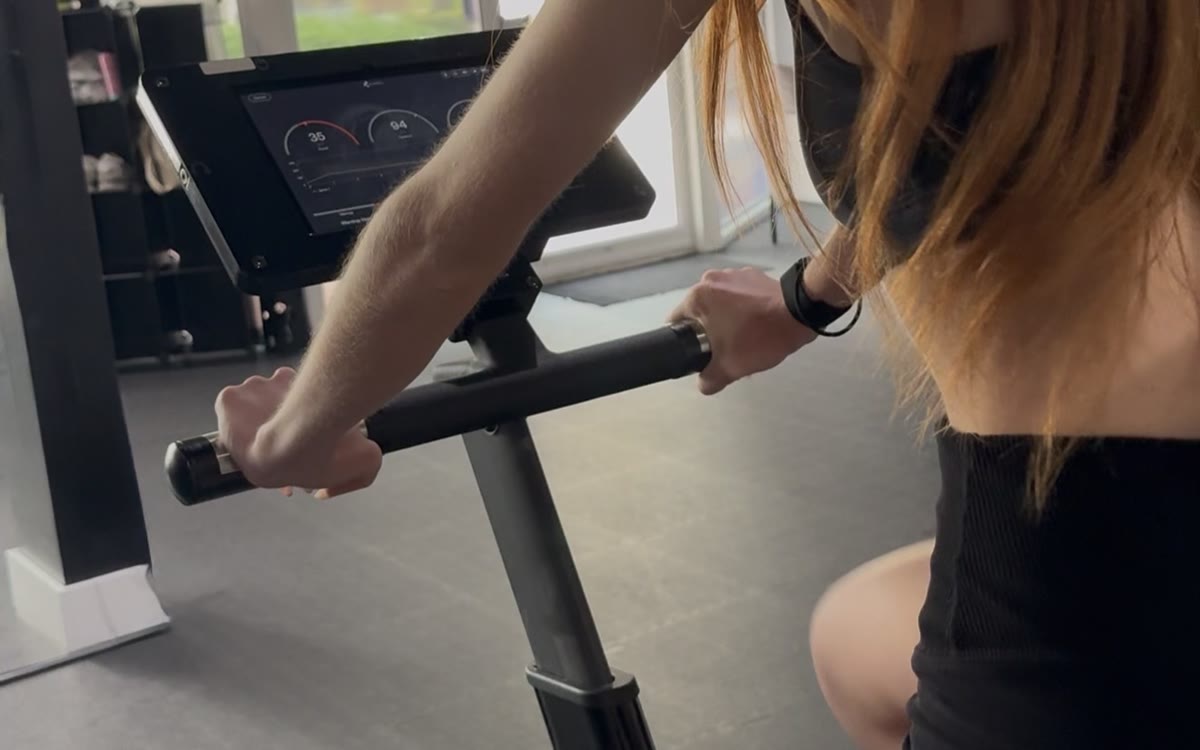
That is the idea behind the CAROL Bike and REHIT, the cardio step in our protocol. REHIT stands for reduced-exertion high-intensity interval training: a short, structured ride where the genuinely hard part is measured in seconds, not miles. Research suggests this style of training can support cardiorespiratory fitness, the system behind VO₂ max, in far less time than traditional cardio.
And because strength is the other half of healthspan, the ride sits alongside about 15 minutes of ARX strength work in the same visit. Engine and chassis, both maintained, inside a lunch break.
How to know where you stand
You do not need a lab to get started. Most fitness watches estimate VO₂ max from your heart rate and pace, and while the estimate is imperfect, the trend line is meaningful. If the number climbs over months of consistent training, your engine is growing.
The takeaway
VO₂ max is worth knowing because it puts a number on something you can feel: how much reserve your body has for life. It responds to training at any age, and you do not need hours of cardio to move it, you need a real stimulus, applied consistently.
The easiest way to see how that fits your week is to feel it. Book a free studio tour and consultation in Downtown St. Pete, about 30 minutes, no pressure, and we will walk you through the whole protocol.
Common questions
- What is VO₂ max in simple terms?
- VO₂ max is the maximum amount of oxygen your body can take in and use during hard exercise. Think of it as the size of your aerobic engine. A bigger engine means everyday effort feels easier and your body has more reserve capacity.
- What is a good VO₂ max for my age?
- It varies by age, sex, and training history, so a single number is not very useful on its own. What matters most is where you sit relative to people your age and which direction your number is moving. A fitness professional can help you interpret an estimate against age-group norms.
- Can you improve VO₂ max after 50?
- Yes. Cardiorespiratory fitness responds to training at any age. Research suggests that interval-style work, short periods of hard effort with recovery in between, is one of the more time-efficient ways to challenge the system that VO₂ max measures.
- Do I need a lab test to know my VO₂ max?
- A true VO₂ max test is done in a lab with a mask that measures your breathing. Fitness watches estimate it from heart rate and pace, which is less precise but useful for tracking direction over time. For most people, the trend matters more than the exact number.
Keep reading
Longevity
How Much Strength Training Do You Actually Need for Longevity?
Less than you think, if the quality is high. A look at how often to strength train for longevity, and why more sessions is not the same as better results.
Longevity
Is It Too Late to Build Muscle After 60?
A common worry after 60 is that the window to build muscle has closed. The research is encouraging: the response to strength training does not expire.